

If we already have a process flow diagram that has been useful in clarifying the stages and interrelationships that will make up the specific process or activity of our venture, business or company; it is also convenient to give more support to our process through the analysis and integration of the environment in which said process or activity will be developed with a SIPOC diagram.
Therefore, creating a SIPOC diagram (Suppliers, Inputs, Process, Outputs, Customers) is a tool that will help us analyze the process and its environment.
The following activities are suggested for the development of the SIPOC diagram.
- Define the boundaries of the process and create its general flowchart specifying the four or five main stages to complete the process.
- For each input and output of the process, define clear objectives that can be measured and transformed into goals to be achieved.
- SSuppliers, Providers or Input Sources. Identify the suppliers, that is, those who provide the raw materials to the process.
- IInput, Inputs or Raw Materials. Establish the inputs (materials, information, etc.) that are necessary for the process to function properly and that are provided by suppliers to be transformed into outputs, products or services.
- PProcess. This is where the raw materials or the results (products or services) generated by the process are transformed and delivered to the customer.
- OOutputs, Finished Products, or Services are provided to the client according to their requirements to meet their needs.
- CCustomers, Clients, or Output Recipients. These are the ones who requested the products or services based on a requirement to satisfy a need.
To illustrate the above, the following image shows a SIPOC diagram for issuing an invoice.
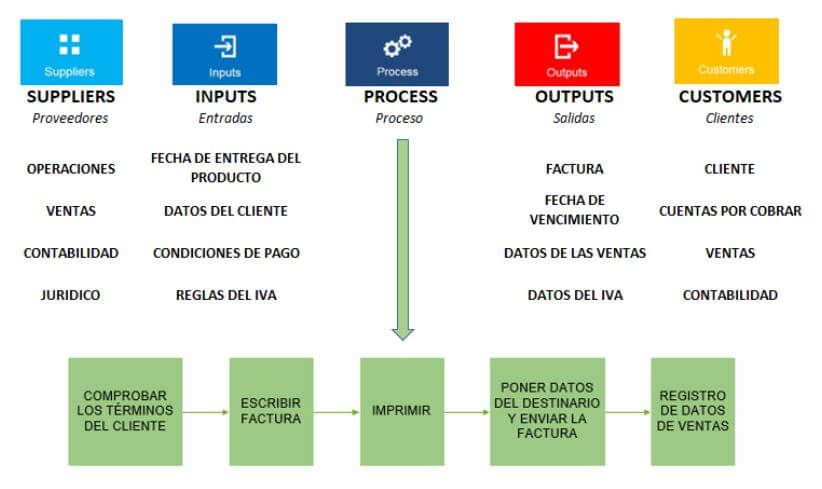
It is common for some details or activities that are part of the process to be overlooked when creating a flowchart. For this reason, it is recommended that the flowchart be drawn as close to reality as possible and only specify activities that are part of the process and that are in accordance with the objective that has been set.
For each critical or important process, it is advisable to develop a SIPOC diagram to visualize the interrelationship between processes and establish the responsibility of each one, preventing errors during the processes, and also allowing us to have a better understanding of the requirements and needs of our clients.
Bibliographic Reference.
Gutiérrez H., & de la Vara R. (2013). Statistical Quality Control and Six Sigma. Mexico: McGraw-Hill.
Image.
refine-ideas-for-your-business.png (1053×584) (yumyumpanda.com)

Consultant and Operations Management Specialist. With over 25 years of experience in the industrial and energy sectors, he has collaborated with business owners in the analysis, planning, negotiation, marketing, administration, and execution of service and maintenance projects.
He has provided executive consulting to board presidents and senior management for strategic decision-making in participating in bidding projects, as well as in the analysis and improvement of their management, operations and industrial safety processes.
If you want to improve and optimize your projects, together we can find the best solution for your industrial needs and ensure your projects are a success.